
Isotopic Control of Vibration-Assisted Quantum Emission
Ryan Kowalski
Vanderbilt University, Nashville, Tennessee, USA _______________________________________
Single-photon-emitting point defects in hexagonal boron nitride (hBN) are promising candidates for quantum technologies due to their bright emission, room-temperature stability, and integration potential with nanophotonic and quantum information systems. These defects exhibit
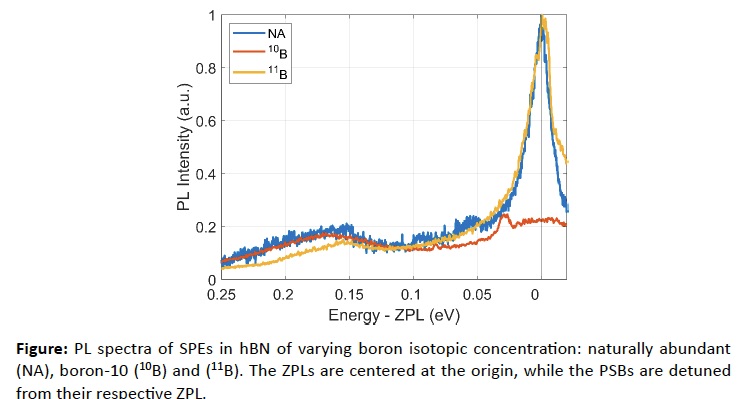
high single-photon purity and ultrafast emission rates, making them valuable for quantum communication, computing, and sensing applications. However, spectral variability poses challenges for reproducibility and has disguised the basic structure of the defect [1]. Several mechanisms might be responsible for the unstable electronic environment, [2,3] but a clearer understanding may be uncovered through the study of the electron-phonon coupling between the intrinsic defect and its host crystal. In this work, we examine the quantum emission in hBN as a function of isotopic concentration of boron in the bulk hBN crystal. Through photoluminescence (PL) spectroscopy, we explore the electron transition as it is unassisted and assisted by phonons at the zero-phonon line (ZPL) and phonon sideband (PSB) replicas. By controlling the bulk phonon frequency (? ~ ?1/m) through isotopic enrichment of the boron isotope (10B and 11B), we demonstrate a shift in the PSB peak from its ZPL (Figure). Examination of the electron-phonon coupling through phonon engineering reveals valuable information about the structure of the defect as well as minimizes phonon broadening, leading to enhanced coherence properties. This work is critical for developing scalable, high-fidelity quantum networks and realizing practical quantum optical devices.
[1] Tran, T. T. et al. Robust multicolor single photon emission from point defects in hexagonal boron nitride. 2017 Conference on Lasers and Electro-Optics, CLEO 2017 – Proceedings 2017-January, 7331–7338 (2017).
[2] Akbari, H. et al. Lifetime-Limited and Tunable Quantum Light Emission in h-BN via Electric Field Modulation. Nano Lett 22, 7798–7803 (2022).
[3]Guo, S. et al. Electrically Driven Site-Controlled Single Photon Source. ACS Photonics (2023) doi:10.1021/ACSPHOTONICS.3C00097/ASSET/IMAGES/LARGE/PH3C00097_0004.JPEG.
Email: ryan.a.kowalski@vanderbilt.edu