
Molten-media-mediated production of hexagonal Boron Nitride: From two-dimensional powder
Zhiyuan Shi
Shanghai Institute of Microsystem and Information Technology, CAS, China
_______________________________________
Fully exploiting the intrinsic characteristics and further promoting the large-scale industrial applications of two-dimensional (2D) materials highly depend on its mass production with efficiency (high-yield, time-saving, and low-cost) and controllability (high-quality, safe, and environmentally friendly). For the mass production of two-dimensional materials, the usage of bubbling as a new tool makes a big difference in multiple aspects of two dimensional materials production [1]. The molten media is employed as the transport media, and the catalyst, which is the crucial factor for the synthesis of 2D materials.
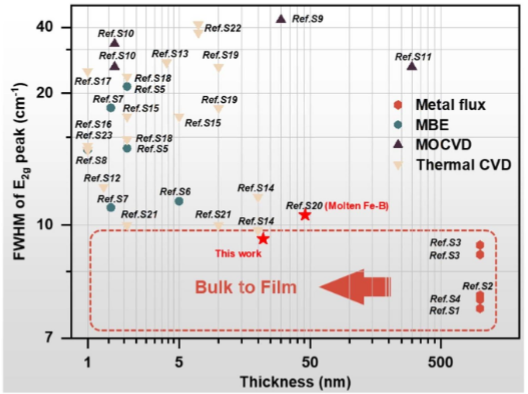
We proposed molten metal-boron alloy for the controllable synthesis of large-area 2D multilayered hexagonal boron nitride (h-BN) films. Combined molten Fe82B18 alloy with N2, the vapor-liquid-solid (VLS) growth strategy was developed to realize the epitaxy-enabled growth of multilayered h-BN on c-facet sapphire substrate [2]. We further introduced molten Ni-B alloy wetting on W, the alloy serves as both the boron source and the growth substrate for synthesizing h-BN multilayers. The full width of half maximum of Raman E2g mode reaches 9.3 cm-1, which is similar to the exfoliated h-BN flakes [3]. The growth mechanism of h-BN on different metal borides was further carried out. Compared with the h-BN grown on Fe2B surface, although the nucleation process of h-BN on Ni3B surface is slower, the quality of the grown film is higher.
Based on the molten metal-boron alloy, we realized mass production of two-dimensional h- BN nanopowders by B-CVD method. Molten Fe-B alloy was chosen as the transport media, the boron source, and the catalyst. Nitrogen gas was injected into the melt to form a gas-liquid binary system. The collected h-BN nanopowders exhibit few-layered (less than 3 nm) feature with large lateral size (more than 100 ?m). The proposed B-CVD method promotes the mass production of two-dimensional materials with high quality and low cost, paving the way to potential applications.
References
[1] Z. Shi, et al., Adv. Funct. Mater. 32, 2203124 (2022).
[2] Z. Shi, et al., Nat. Commun. 11, 849 (2020).
[3] Y. Zhu, Z. Shi, et al., 2D Mater. 11, 035033 (2024).
[4] Y Guo, Z. Shi, et al., Appl. Surf. Sci., 684, 161837 (2025).
Email: shizhy@mail.sim.ac.cn