
Microscopic model for optically addressable spin defect pairs in hBN
Viktor Ivády
Eötvös Loránd University – Budapest, Hungary
_______________________________________
Optically detected magnetic resonance (ODMR) signals without resolvable zero-field splitting have been observed in hexagonal boron nitride across a broad spectral range, yet their microscopic origin is still unrevealed. Recent studies suggest that charge-transfer-induced spin pairs involving common point defects could naturally explain the key experimental features. We propose a microscopic model for the point defects responsible for the observed optically addressable spin pairs in hBN. Based on general considerations and first-principles calculations, we identify substitutional carbon-based defects, specifically donor-acceptor pairs (DAPs) of CB-CN, as likely candidates for the bright defect (defect A), coupled to a dark single-site CB or CN defect (defect B). This model explains the broad spectral emission range and spin-selective transitions via a charge-transfer metastable state. Our computed energy levels, optical properties, and electron spin resonance linewidths align well with experimental observations. The model can be extended to other donor-acceptor defect complexes, offering a framework for understanding diverse spin-active centers in hBN.
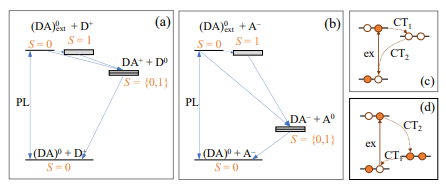
Figure 1. DA0+D+ and DA0+A- models for optical spin defect pairs. Electronic structure and possible transitions of optical spin defect pair, with (a) remote donors and (b) a remote acceptors. (c) and (d) visualize non-radiative spin selective decay of the DA0+D+ and DA0+A? models. CT1 and CT2 stand for charge transfer processes.
Email: ivady.viktor@ttk.elte.hu