
Understanding the decoherence of the V?B center in hexagonal boron nitride
András Tárkányi
Eötvös Loránd University, Budapest, Hungary
_______________________________________
The negatively charged boron vacancy (VB?) in hexagonal boron nitride stands out asone of the leading point defects, enabling groundbreaking applications in the rapidly advancing fields of quantum sensing and quantum communication. Recent advances in defect creation and fabrication technologies have facilitated measurements in material and life sciences with unprecedented sensitivity. Investigating the coherence properties of such defects is therefore crucial for driving further innovation in these areas. Modeling the behavior of correlated many-body spin systems requires a fully quantum mechanical framework, and, to make computations feasible, the generalized cluster-correlation expansion (gCCE) is implemented, incorporating correlations of various orders into the predictable dynamics of small, iteratively defined nuclear spin clusters. In this work, we simulated the Hahn echo coherence time of the VB? defect embedded in a nuclear spin bath across a broad range of external magnetic fields (from 0 to 3 Tesla) with high resolution. Leveraging diverse numerical and theoretical techniques, we identified three distinct regimes characterized by qualitatively different coherence dynamics. For each regime, we provided a detailed analysis of the nuclear spin clusters and interactions primarily responsible for decoherence. These findings offer a pioneering framework for understanding and quantitatively describing the coherent dynamics of similar point defects in nuclear-noise-dominated environments.
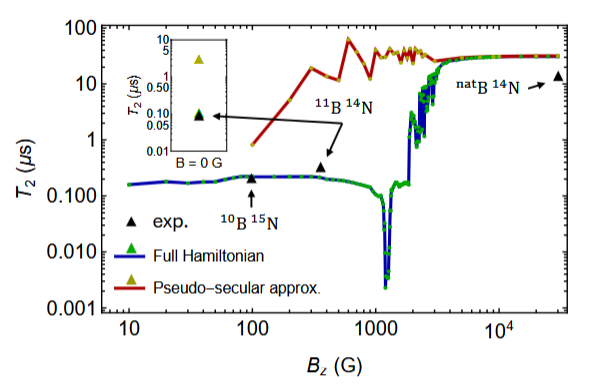
Figure 1. Simulated magnetic field dependence of the Hahn echo coherence time T2 (solid lines) compared with available experimental measurements (black triangles) of VB? center in h11B15N.
Email: andras.tarkanyi22@gmail.com