
Probing broadband spin-relaxation dynamics of boron-vacany centers in hexagonal boron nitride: towards high field spin-based quantum sensing
Yueh-Chun Wu
Oak Ridge National Laboratory, Oak Ridge, Tennessee, USA _______________________________________
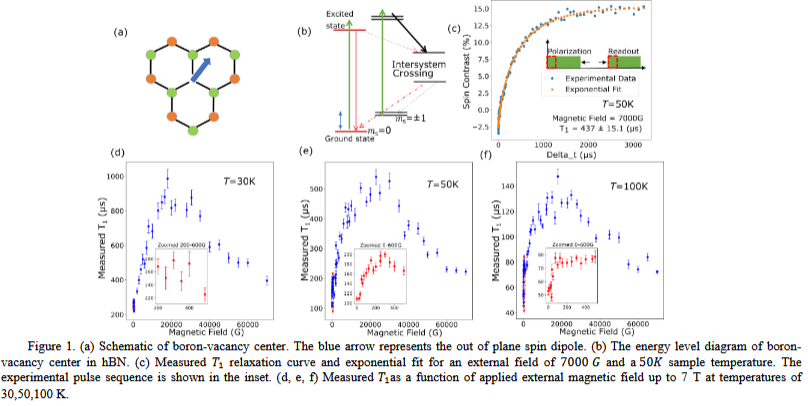
Spin defects like the boron-vacancy center (???) in hexagonal boron nitride (hBN) have attracted significant attention in recent years for their potential applications in quantum sensing because of their ease of fabrication and their straightforward integrability with van der Waals heterostructures. The ??? ground state is a spin triplet state (? = 1) that is further split into ?? = 0, ±1 sublevels by a zero-field splitting of 3.5 ???. The ground state splitting is sensitive to external magnetic fields via Zeeman effect and electric fields via Stark effect, enabling the spin defects to serve as in situ probes of these quantities with high spatial resolution. The sensitivity of these defects to external magnetic fields at ?? ? ??? frequencies is closely related to the linewidth of the ground-state spin transition, the lattice environment of the host material, and the intrinsic spin-relaxation time (?1) and decoherence time (?2). While ?1 is influenced by spin-spin interactions and spin-phonon interactions, ?2 is governed by the coupling of the ground state spin with the nuclear spins in the environment. The effect of a small ?2 can be circumvented by applying appropriate microwave pulse sequences to filter the environmental noise. However, the upper limit of the effective ?2 time is determined by the ?1time. Therefore, it is critical to understand the nature of the relaxation dynamics of the ??? defects as the community begins to develop new approaches to quantum sensing with 2D spin defects.
Here, we focus on magnetic field and temperature dependent spin relaxation dynamics of ??? defects for fields of 0 ? 7 ? (corresponding to ground-state splitting ~3.5 ?? 200 ???) and temperatures of 2 ? 300 ?. In general, magnetic fields aligned perpendicular to a spin dipole because the ??? spin is aligned out-of-plane, it is reasonably Spin relaxation processes at low temperatures are commonly ascribed to two-phonon processes or Orbach type process due to coupling with quasilocalized phonons. We show here that, while the measured spin contrast is relatively independent of field, the ?1 time is strongly field dependent with the maximum measured ?1 occurring around 1.8 ?, suggesting an intrinsic magnetic-field-dependent relaxation mechanism. If time allows, we will also discuss ongoing experiments focused on milliKelvin temperature-dependent probes of ?1 and ?2 for ??? and for carbon spin-defects in hBN. Together, our results provide insights into the nature of spin-phonon coupling and highlight the potential of these defects for quantum sensing in high magnetic fields and milliKelvin environments.
Email: wuy2@ornl.gov